A young person doesn't need a robot job title to start learning robotics. They need a safe way to build, test, break, and fix a system that responds to the world.
The best preparation starts with practical work. It connects maths, coding, design, and judgement to something they can see moving on a table.
Quick read
- Start with small robots that make one clear movement or choice.
- Teach testing and repair alongside coding.
- Add safety, privacy, and human judgement from the first project.
Start with a task and test the full loop
“Learn robotics” is too broad for a young person. A better first task has a clear result: move a small object, follow a line, avoid a wall, or sort items by colour.
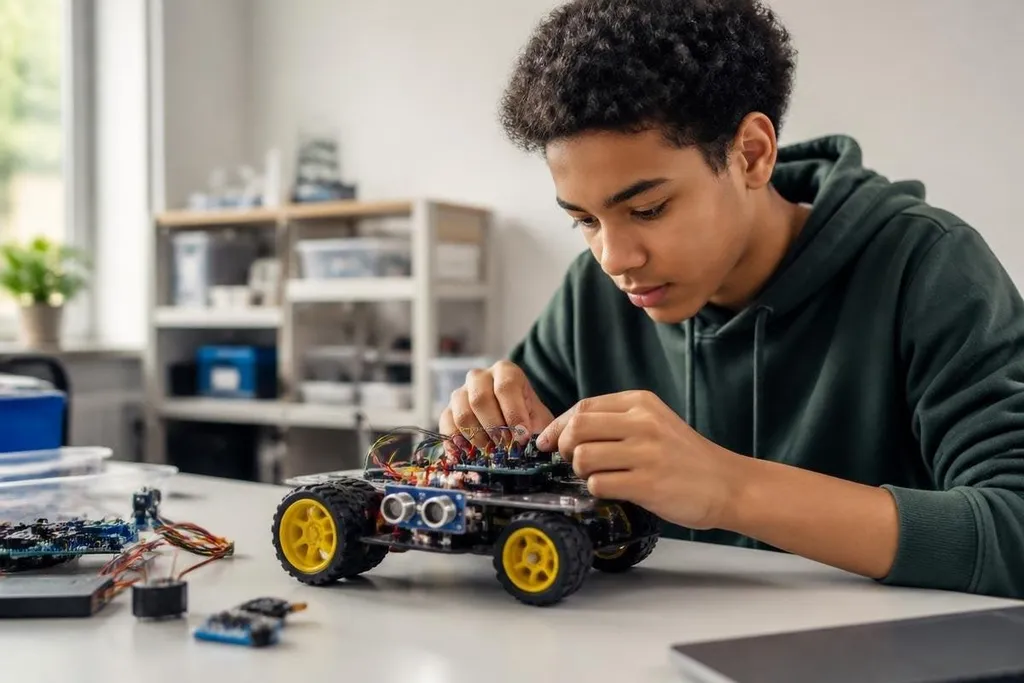
That task gives each lesson a reason. A sensor reads the world, code makes a choice, and a motor carries out the action. When the robot fails, the student has a real problem to inspect instead of a worksheet with an answer already marked.
Keep the first build small enough to finish. A table-top robot with one sensor and two motors can teach input, code, power, motion, and testing without burying the student in parts.
The project should also leave room for changes. Ask the student to alter one rule, test the result, and record what changed. That habit matters in robotics because a system can work on a clean table and fail when the light, surface, or object changes.
Coding gets attention because the result appears on a screen. Robotics adds the physical part, where loose wires, weak batteries, blocked sensors, and poor wheel grip can change the result.
A useful lesson starts by defining the task and writing down what counts as success. The student can then build one part, test one change at a time, record what happened, and explain why they changed the design.
This approach builds patience without turning the lesson into a lecture. It also shows that a failed run contains useful information. The student can check the sensor reading, inspect the cable, or compare the code with the intended action.
For adults planning lessons, a 30-minute build session can work better than a large project with no clear stopping point. End each session with one saved program, one note, or one measured result.
Add people, rules, and access
Robotics affects people, so technical skills need company. A young person should learn why an emergency stop exists, why moving parts need space, and why a camera should not record people without permission.
Safety can start with plain habits: switch off power before changing wiring, keep fingers clear of gears, secure loose cables, and test at low speed. Those rules are easier to remember when the student sees the hazard in the build.
Privacy needs the same treatment. If a project uses a camera or microphone, decide what it records, where the data goes, and when the system deletes it. A robot that can collect data needs limits before it needs more features.
Ethics also belongs in project reviews. Ask who benefits, who might be left out, and what happens when the system makes a poor choice. These questions prepare students for work where a person remains responsible for the machine's actions.
A project review becomes more useful when students compare their choices with machines used outside school. They can read reports on real robots about companies, machines, and research, then ask how those examples relate to their own work.
Not every young person has a robotics kit, a workshop, or an adult who can debug code. Schools, libraries, clubs, and families can use shared equipment and rotate roles so more students get time with the hardware.
A group project can assign roles such as builder, coder, tester, and recorder. Change those roles during the project. The student who starts with notes may later wire the sensor, while the first coder checks the physical design.
Use tools that show cause and effect clearly. Block-based code can help at the start, while text code can follow when the student needs finer control. The tool should serve the task, not become the task.
A practical check before starting
Use this guide when choosing a first robotics project:
- Clear result: Can the student describe success in one sentence?
- Safe setup: Can an adult stop power quickly and reach the moving parts?
- Small parts count: Does the project need only the hardware required for its first test?
- Visible feedback: Can the student see or measure what the sensor and motor do?
- Repair time: Is there enough time to inspect one failure instead of hiding it?
- Room to grow: Can the same build accept a new rule or sensor later?
I’d start with the smallest project that lets a young person make a prediction, run the robot, and explain the result.
That process prepares them for robotics work better than a promise about future jobs. The next useful project is the one where they can change one part, test it, and see what the machine does.